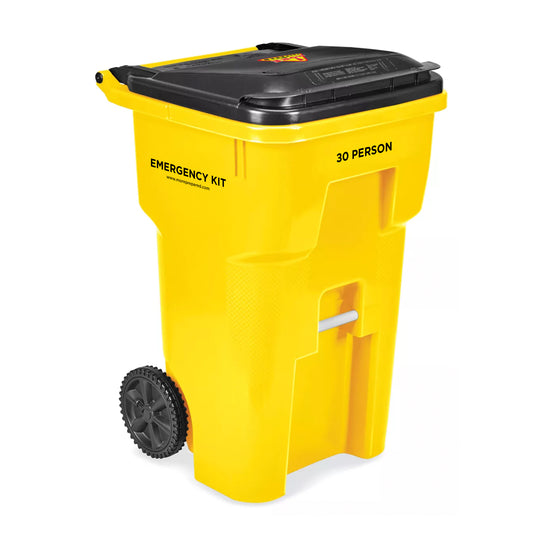
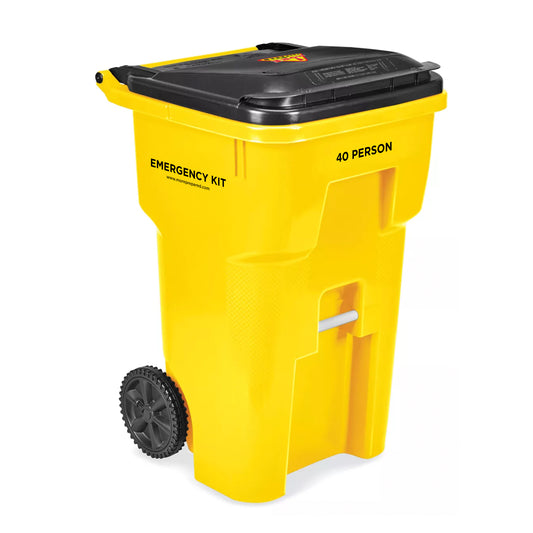
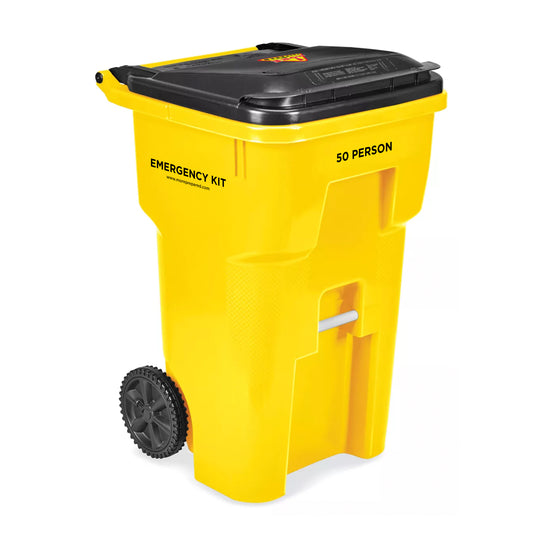
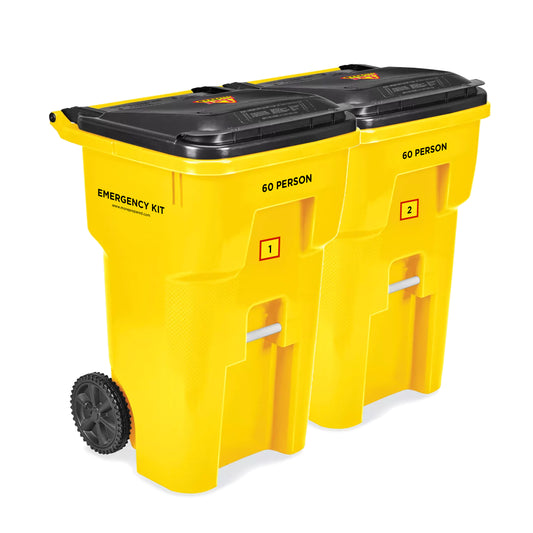
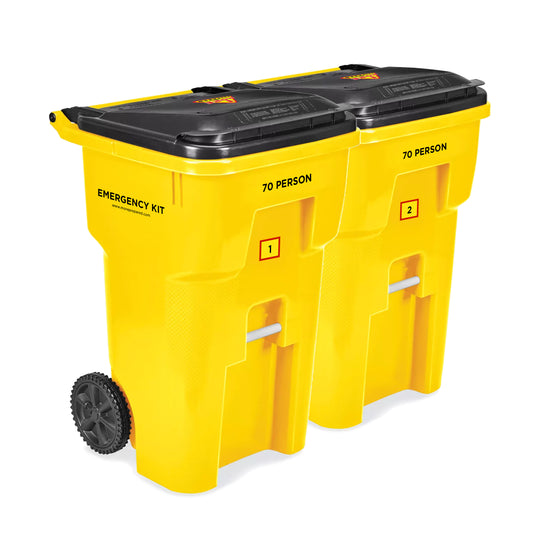
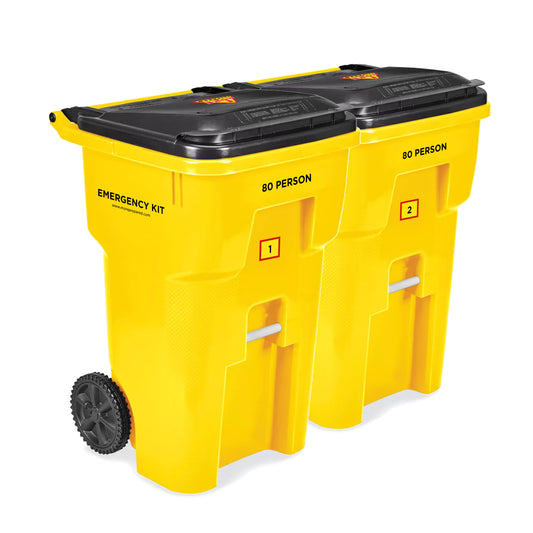
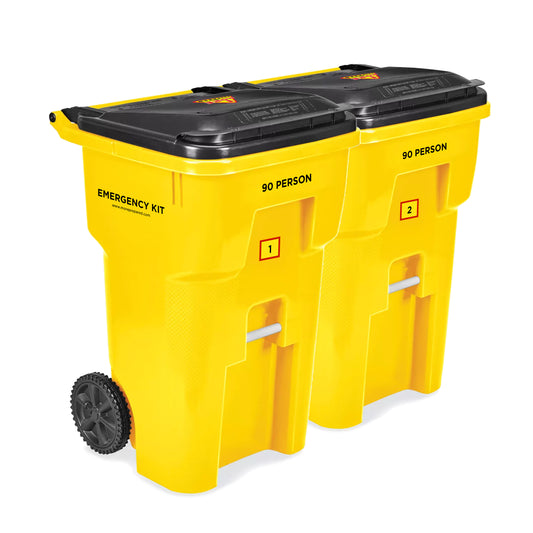
Medium workplace kits support emergency planning by staging essential supplies directly at the department or floor level, where employees can access items during the early stages of an incident. This scale is intended for organizations with 21 to 99 personnel, including corporate offices, retail operations, medical groups, call centers, warehouses, and multi suite buildings. Kits are configured so each floor or department has immediate access to water, food, lighting, sanitation supplies, and first aid resources while continuity actions begin.
A common deployment approach uses wheeled bins sized to the number of employees. Kits for 30 to 50 personnel are packed into one wheeled bin for centralized placement, and kits for 60 to 90 personnel use two wheeled bins so each floor or department can access supplies without congestion during shelter in place.
Supplies are evenly distributed across the bins to create redundancy. If one location becomes inaccessible, other bins still provide the complete set of essential items for the assigned personnel. Per employee items such as food bars, water pouches, blankets, and masks are allocated proportionally across the kit configuration.
This planning structure supports short duration shelter in place procedures and aligns with common emergency guidance for 72 hour preparedness. Contents include long shelf life food and water, first aid supplies, sanitation items, lighting, blankets, basic tools, and communication materials suitable for earthquakes, power outages, evacuation delays, and shelter in place events. Standardized configurations support training, simplify rotation cycles, and allow organizations to deploy the same kit model across multiple locations or floors.
FAQ
How are kits packaged for different employee sizes? Kits for about 30 to 50 personnel use one wheeled emergency bin. Kits for about 60 to 90 personnel use two wheeled bins so each floor or department has direct access.
Why are supplies distributed across multiple bins? Supplies are divided evenly so each bin can support its assigned number of employees. This creates redundancy and improves access if one area cannot be reached during an emergency.
How many employees does each bin support? Each wheeled bin typically supports about 30 to 50 employees. Kits for 60 to 90 employees use two bins, each carrying supplies for its assigned group.
Where should bins be placed? Kits are usually staged per floor or department. Placement near shared work areas or along internal evacuation routes allows faster access during shelter in place conditions.
Do these kits include food and water for everyone? Yes. Food bars and water pouches are allocated evenly across bins to support the planned staff count for approximately 72 hours.
Can kits be customized for building layout? Yes. Additional bins, trauma kits, radios, PPE, or floor specific add-ons can be added. Kits can also include company branding with printed logos or custom sticker labels to support identification and deployment across multiple floors or locations.
What if we have fewer than 30 or more than 99 employees? Organizations with 21 to 29 employees can start with our smallest Medium kit and add a supplemental pail if needed. Organizations with 100 or more employees should see our Large Workplace Emergency Kits, sized specifically for that range.
Purchasing Kits for an Organization
More Prepared supports single-location and multi-site workplace preparedness programs. We can help determine kit quantities and placement based on employee headcount, shift coverage, floor layout, departments, and designated shelter-in-place areas.
Purchase orders, tax-exempt purchasing, volume pricing, custom
configurations, organization labeling, and multi-location delivery are available for qualifying businesses, schools, healthcare facilities, and public agencies.
Request a quote for medium workplace kits →
quotes@moreprepared.com | 888.733.7245